why same-GPU coexistence has a ceiling
chunked prefill makes prefill-decode coexistence more tolerable by slicing the prefill into small pieces. but even with perfect chunking, prefill and decode are still sharing the same GPU. they compete for:
- HBM bandwidth — both need to read from and write to GPU memory each iteration
- compute units — prefill’s GEMM and decode’s GEMV contend for the same tensor cores
- KV cache space — prefill temporarily occupies blocks that could serve decode requests
at moderate scale, this coexistence is acceptable. at large scale — thousands of requests/second, strict SLOs, multi-GPU clusters — the competition becomes a bottleneck that chunking alone cannot resolve.
step back and look at what prefill and decode actually need from the hardware:
| property | prefill | decode |
|---|---|---|
| operation type | GEMM — matrix × matrix | GEMV — vector × matrix |
| compute bottleneck | compute-bound (tensor cores) | memory-bandwidth-bound |
| arithmetic intensity | high — \(\sim O(L \cdot d)\) FLOP/byte | very low — \(\sim O(1)\) FLOP/byte |
| ideal GPU MFU (model FLOP utilization) | 50–70% | 5–15% |
| KV cache lifetime | transient — computed, then handed off | persistent — grows with every generated token |
| sensitivity to batch size | low — throughput scales with \(L\) already | high — larger batch amortizes the per-step bandwidth cost |
the two workloads want opposite things. prefill wants to compute aggressively on large matrices and doesn’t care much about its KV cache footprint because it will be handed off soon. decode wants a large concurrent batch to amortize bandwidth, and needs a stable, long-lived KV cache.
forcing them to share a GPU means neither gets what it wants.
disaggregated prefill architecture
the solution: route prefill and decode to different GPU instances.
flowchart TB
  request["incoming request"]

  subgraph prefill["Prefill Instance Pool"]
    p0["GPU-P0"]
    p1["GPU-P1"]
    p2["GPU-P2"]
    p3["GPU-P3"]
    prefill_work["run full prefill<br/>compute KV cache"]
  end

  network["network<br/>NVLink / InfiniBand / RoCE"]

  subgraph decode["Decode Instance Pool"]
    d0["GPU-D0"]
    d1["GPU-D1"]
    d2["GPU-D2"]
    d3["GPU-D3"]
    decode_work["receive KV cache<br/>autoregressive decode"]
  end

  request --> prefill_work
  p0 --- prefill_work
  p1 --- prefill_work
  p2 --- prefill_work
  p3 --- prefill_work
  prefill_work -- "KV transfer" --> network --> decode_work
  decode_work --- d0
  decode_work --- d1
  decode_work --- d2
  decode_work --- d3
the flow for a single request:
- a prefill instance receives the request and runs the prompt through a full forward pass, producing the KV cache and the first generated token
- the KV cache is transferred to a decode instance over the network
- the decode instance takes over and runs autoregressive generation until EOS
from the decode instance’s perspective, it receives a ready-to-use KV cache and immediately starts generating — it never touches a prefill workload again.
why this helps each side
prefill instances can now:
- run at maximum compute utilization without decode traffic disrupting memory bandwidth
- handle longer prompts without worrying about KV cache lifetime because KV is handed off immediately
- use tensor parallelism aggressively — prefill is embarrassingly parallel over the prompt tokens
decode instances can now:
- maintain a much larger concurrent batch, because all resident requests are decode-only
- keep KV cache layout stable and compact, with no interleaving against short-lived prefill KV blocks
- apply prefix caching within the decode pool without interference
both SLO metrics decouple:
| metric | mixed (chunked prefill) | disaggregated |
|---|---|---|
| TTFT | limited by prefill queue on shared GPU | controlled by prefill pool sizing |
| TPOT | affected by prefill chunks sharing iteration | isolated — decode never sees prefill |
once disaggregated, you optimize TTFT by adding prefill instances, and TPOT by adding decode instances. the two knobs no longer conflict.
the engineering challenge: KV cache migration
the elephant in the room: transferring the KV cache from a prefill instance to a decode instance is expensive.
how much data moves?
for a model with \(L\) layers, \(n_h\) KV heads, head dim \(d_h\), and BF16 precision:
$$
\text{KV bytes per token} = 2 \times L \times n_h \times d_h \times 2
$$
for LLaMA-3 70B (GQA: \(L = 80\), \(n_h = 8\), \(d_h = 128\)):
$$
2 \times 80 \times 8 \times 128 \times 2 = 327{,}680 \text{ bytes} \approx 320 \text{ KB per token}
$$
| prompt length | KV cache to transfer |
|---|---|
| 1K tokens | ~320 MB |
| 8K tokens | ~2.5 GB |
| 32K tokens | ~10 GB |
this is per request. at 100 requests/second with 4K-token prompts, the cluster needs to sustain ~100 GB/s of KV transfer.
network bandwidth requirements
assume a prefill pool sustaining 10K tokens/second throughput:
$$
\text{required bandwidth} = 10{,}000 \times 320 \text{ KB} = 3.2 \text{ GB/s}
$$
how different interconnects compare:
| interconnect | bandwidth | sufficient? |
|---|---|---|
| NVLink (same-node multi-GPU) | ~900 GB/s | trivially — not a bottleneck |
| InfiniBand HDR (200 Gb/s) | ~25 GB/s | yes, with headroom |
| RoCE (100 GbE) | ~12.5 GB/s | borderline at high concurrency |
| standard Ethernet (10 GbE) | ~1.25 GB/s | insufficient |
the practical conclusion: same-node disaggregation over NVLink is essentially free; cross-node disaggregation requires InfiniBand or RoCE with RDMA. ordinary ethernet cannot sustain the transfer rate at production scale.
pipelining the transfer
naively, the prefill instance completes all \(L\) layers, then transfers the entire KV cache. the decode instance waits for the full transfer before generating the first token.
this adds \(T_{\text{transfer}}\) to TTFT:
$$
\text{TTFT} = T_{\text{prefill}} + T_{\text{transfer}} + T_{\text{decode_queue}}
$$
the optimization: pipeline the transfer layer by layer. as soon as layer \(l\) finishes on the prefill instance, transfer its KV slice immediately — overlapping transfer with the remaining prefill computation for layers \(l+1, \ldots, L\):
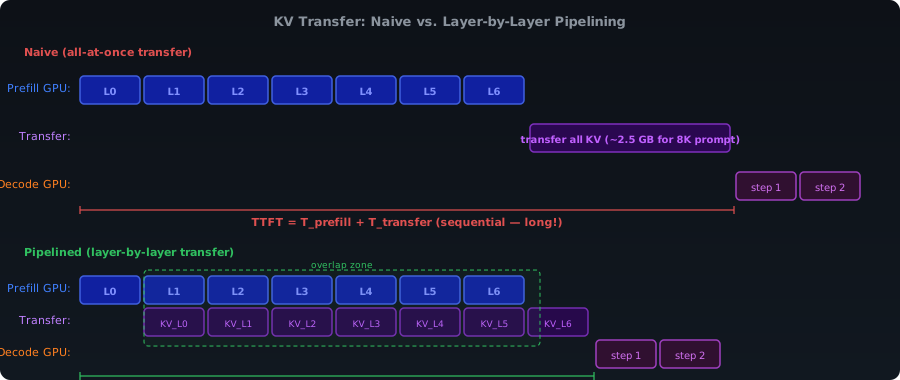
Figure 1: naive transfer (top) sends the full KV cache after all layers complete, adding T_transfer to TTFT. layer-by-layer pipelining (bottom) overlaps transfer with ongoing prefill computation, hiding most of the transfer cost.
with perfect pipelining, \(T_{\text{transfer}}\) overlaps with \(T_{\text{prefill}}\) and adds only a small residual latency. in practice, the overlap is imperfect because of RDMA setup overhead and layer-size granularity, but even partial overlap substantially reduces effective TTFT.
scheduling and scaling the two pools
disaggregated architectures need a global scheduler that coordinates both pools:
flowchart TB
  request["incoming request"] --> scheduler

  scheduler["Global Scheduler<br/>1. select prefill GPU<br/>2. select decode GPU<br/>3. monitor KV transfer<br/>4. load balancing"]

  scheduler --> prefill["Prefill Pool<br/>P0 / P1 / P2 / ..."]
  scheduler --> decode["Decode Pool<br/>D0 / D1 / D2 / ..."]
  prefill -- "KV cache" --> decode
scheduler decisions
prefill instance selection: route requests to the prefill instance with the shortest queue. prefill throughput is predictable because it is roughly proportional to prompt length, so load can be estimated ahead of time.
decode instance selection: route to the decode instance with the most available KV cache space and that is topologically close to the selected prefill instance, minimizing transfer distance.
KV cache affinity: if the decode instance already has a cached prefix that matches this request’s prompt, route to that instance to reuse the cached blocks — avoiding transfer for the cached portion entirely.
independent scaling
the core economic argument for disaggregation is elastic, independent scaling.
in a mixed architecture, to handle a 2× increase in either prefill or decode load, you must scale the entire cluster — even if only one side is the bottleneck.
with disaggregation, you scale each pool independently:
| load pattern | optimal configuration |
|---|---|
| long prompts, short outputs | more prefill instances, fewer decode |
| short prompts, long outputs | fewer prefill, more decode |
| balanced | roughly equal pools |
| burst of new requests | scale prefill temporarily |
observed ratios from production systems: the Splitwise paper (Microsoft, 2024) analyzed real Azure LLM traffic and found the optimal prefill:decode instance ratio is approximately 1:3. one prefill instance can serve three decode instances before becoming the bottleneck — reflecting that decode is the longer phase for typical generation lengths.
real systems and the broader principle
DistServe (2024)
DistServe systematically analyzed optimal parallelism strategies for each pool:
- prefill instances prefer tensor parallelism — a single long prompt benefits from splitting the attention computation across GPUs within the same forward pass
- decode instances prefer pipeline parallelism — many concurrent short decode steps benefit from pipelining across GPU stages, which reduces the all-gather communication overhead per token
DistServe’s key finding: the optimal strategy for each phase differs, so letting them share a GPU forces a suboptimal compromise.
Mooncake (Kimi, 2024)
Mooncake introduced a KVCache-centric architecture treating the KV cache as a first-class distributed object:
- prefill instances write KV to a distributed KV store accessed via RDMA
- decode instances read directly from the store, bypassing CPU
- prefix caching works across the distributed store — a cached prefix computed on P0 can be reused by a request routed to P1 without re-transfer
Mooncake effectively turns KV cache management into a distributed storage problem, with all the consistency and locality optimizations that implies.
Splitwise (Microsoft, 2024)
Splitwise validated disaggregation on real production traffic from Microsoft Azure:
- for long-prompt workloads: TTFT reduced by 90%+
- for long-generation workloads: throughput improved by 2×+
- optimal prefill:decode ratio: approximately 1:3
separation of concerns
there is a deeper pattern here. throughout computer systems, forcing heterogeneous workloads to share resources leads to mutual degradation. the solution is always the same: identify the resource requirements of each workload, and give each workload resources matched to its needs.
- databases: read replicas vs. write-primary
- CPU pipelines: in-order vs. out-of-order execution units
- network: control plane vs. data plane separation
- LLM serving: prefill (compute-bound) vs. decode (memory-bound)
disaggregated prefill is the application of this principle to LLM inference. the cost is coordination: KV cache must be serialized, transferred, and deserialized — adding a new failure mode and latency component. but when the cluster is large enough and the network is fast enough, the coordination overhead is small relative to the gains from running each workload at its optimal operating point.
summary
disaggregated prefill takes the next logical step after chunked prefill: instead of interleaving prefill and decode on the same GPU, separate them onto dedicated pools.
the payoff:
- TTFT and TPOT decouple — each is now an independent variable controlled by pool sizing
- each pool runs at its optimal operating point — prefill at high compute utilization, decode with large batch sizes saturating HBM bandwidth
- independent, cost-efficient scaling — add prefill capacity for long prompts, decode capacity for long outputs, independently
the cost:
- KV cache migration across the network — requires InfiniBand or RDMA for cross-node transfers at production scale
- global scheduler complexity — must coordinate two pools, manage KV affinity, and handle transfer failures
- increased operational complexity — two pools to monitor, tune, and autoscale independently
at moderate scale, chunked prefill is the pragmatic choice. at large scale with strict SLOs, disaggregation is increasingly the industry direction — as evidenced by Kimi (Mooncake), Azure (Splitwise), and the broader adoption in production serving stacks.